Read This First
You are not broken. You are running on the wrong inputs.
If you're reading this, something inside you already knows. The diets stopped working. The workouts stopped working. The "just push through" stopped working. And somewhere along the way, you started wondering if you were the problem.
You are not the problem. Your inputs are.
This guide walks you through the six resets your body needs — in the order it needs them. Read it slowly. Underline things. Argue with parts of it. The point isn't to do everything at once. The point is to finally understand what's actually happening inside you, so the 10-day reset waiting for you next actually lands.
Before we begin
This Was Me
The before, the in-between, and what finally worked.

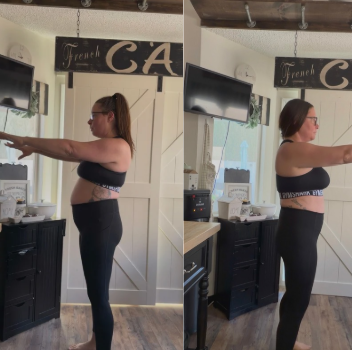
I was:
- waking up puffy
- bloated after eating
- obsessing over food constantly
- anxious in my body
- relying on caffeine
- overtraining
- inflamed no matter what I tried
I kept thinking: "maybe I just need more discipline." But the harder I pushed… the worse my body responded.
I stopped trying to force results and started helping my body feel safe.
That's what created:
- less inflammation
- a flatter stomach
- better digestion
- stable energy
- less food obsession
- a calmer nervous system
- sustainable fat loss
Welcome
Welcome to the Triple-9 Reset
The promise, the truth, and what this is (and isn't) before you turn the page.
If you're reading this, you're tired of being tired. You've cut calories, started over on Mondays, and choked down meal plans that left you hungry and cooking separately from your family. Maybe you've started to wonder if your body is just working against you.
As someone who's navigated thyroid cancer, hormonal chaos, stress, and stubborn weight that wouldn't budge — I get it. This reset wasn't built in a lab. It was built from my own kitchen, on my own busy days, when I needed something that actually fit my life.
Over 10 days I lost 9.2 pounds and 9 total inches eating real food, prioritizing protein, fiber, and water (fiber is the unsung hero — it heals your gut), moving consistently, and taking one full rest day. Nine active days. Hence the name. 😉
You don't have to punish your body to support it. You don't have to be perfect to make progress. And you absolutely don't have to do this alone.
What this reset IS
- A 10-day jumpstart to reduce bloat and inflammation and rebuild momentum.
- A simple plan built on real food and sustainable habits.
- A way to feel like yourself again — without hours in the kitchen or gym.
What it is NOT
- Not a detox. Not a starvation diet. Not a "never eat pizza again" plan.
- Not a 2-hour workout program. Not a quick fix you abandon on day 11.
Write yourself a letter first
Before day 1, write a letter to yourself about what you want to feel by the end of day 10. Not just the scale — the feeling. More energy. Jeans that fit. Patience for your people. Sleeping through the night. Stop crying at the mirror.
Stick it next to your bed. Read it on the hard days. Every goal I've ever hit started with a letter and a why. Yours starts the same way.
Start Here
How To Use This Guide
Eight steps. One rest day. Zero guilt if you mess up.
- Read everything before day 1. Don't skim — this is the part most women skip and then wonder why it didn't stick.
- Do your grocery shopping (two trips — one for days 1–5, one for days 6–10).
- Prep ahead where you can. Future-you is tired. Make it easy on her.
- The morning of day 1: take your starting weight first thing in the morning, after the bathroom, before eating or drinking anything — and take your starting measurements (waist, hips, bust/chest, thighs, arms). Snap a before photo too if you're up for it. You'll want these in 10 days.
- Start with Day 1 and follow each day in the order it's given to you (there's a note for workout times if the timing doesn't work for you).
- Pick one rest day that fits your week. I used day 7. Skip the workout that day, not the meals.
- Celebrate at the end of day 10. Out loud. In the mirror. You earned it.
- Use the "what to do next" section at the end so you keep losing 1–2 lbs a week after the reset is over.
If you miss a meal or a workout — don't quit. Just pick back up at the next one. That's the entire secret.
The Setup
Grocery, Prep & Meal Prep
The easier you make the healthy choice, the more likely you are to make it. That's the whole game.
This isn't a "diet food" haul. Most ingredients repeat across the 10 days on purpose — less waste, less decision fatigue, less money spent eating out. You'll probably spend less at the grocery store than you do in a normal week.
Budget-friendly swaps
- Frozen veggies instead of fresh.
- Conventional produce if organic isn't accessible.
- Big tubs of Greek yogurt instead of single cups.
- Ground turkey if beef isn't on sale.
Shopping Trip #1 — Days 1–5
Protein
- 2 large tubs plain non-fat Greek yogurt (32 oz)
- 1 dozen eggs · 1 lb bacon · 32 oz cottage cheese
- 2 lbs 90/10 ground beef · 2–3 lbs chicken breast · 1 lb chicken thighs · 1 rotisserie chicken
Produce
- 2 pints blueberries · 4 lemons · 1 piece fresh ginger
- 2 large sweet potatoes · 1 large spinach · 2 heads romaine
- 2 zucchini · 1 head broccoli · 1 bag sugar snap peas · 2 lbs green beans · 1 bag carrots
- 2 red onions · 1 jar jalapeños · 2 avocados
Dairy
- Grated parmesan · shredded parmesan · shredded cheddar
Shopping Trip #2 — Days 6–10
Protein
- 2 sirloin steaks · 1–2 lbs chicken breast · 1 lb 90/10 ground beef
Produce
- 1–2 sweet potatoes · 1 lb green beans · 1 pineapple · 1 zucchini · 1 red onion · 1 avocado · romaine
Restock as needed
- Greek yogurt · eggs · blueberries · cottage cheese
Pantry staples (check before shopping)
Chia seeds · honey · Ceylon cinnamon · chili powder · cumin · smoked paprika · oregano · black pepper · cayenne · Redmond Real Salt · garlic-infused olive oil · coconut aminos · apple cider vinegar · dijon mustard · hot sauce · salsa.
Prep like a busy woman
I stopped expecting myself to make healthy choices when I was already exhausted. Instead, I made the healthy choice the easy one.
- Hard-boil a batch of eggs (breakfast in a pinch, snack when you're starving).
- Wash and chop your lettuce.
- Bake sweet potatoes in batches.
- Brown a few servings of ground beef.
- Make a triple batch of the homemade taco seasoning.
- Grab a rotisserie chicken (or pre-cook a few days of lean protein).
- Prep yogurt bowls the night before.
- Stock the freezer with veggies.
The easier you make the healthy choice, the more likely you are to make it. Consistency is where the magic happens.
Daily Habits
The Foundations That Do the Heavy Lifting
Water, sunlight, sleep, walking, strength. These aren't the bonus — they ARE the reset.
Water — aim for 100 oz (84 oz minimum)
It sounds like a lot. Here's why it matters: water flushes your liver (your fat-burning organ), drops excess sodium, and tells your body it's safe to release the water it's been hoarding. Dehydration makes your body hold on for survival — hydration tells it to let go.
Other benefits:
- Less inflammation — your lymphatic system needs water to clear waste from tissues.
- Better metabolism — supports lipolysis (fat breakdown).
- Appetite control — a glass 30 min before meals = naturally smaller portions.
- Joint lubrication — less stiffness, less inflammation pain.
The first 30 minutes of your morning
Two small shifts I made before worrying about anything else:
- 10 minutes of morning sunlight within the first hour of waking. Sets your sleep-wake cycle, supports cortisol rhythm, lifts mood, increases daytime energy.
- Stop hitting snooze. Every alarm spikes stress hormones and fragments your sleep. Repeated alarms = more tired, not less. Go to bed earlier instead and get up the first time.
Coffee + caffeine
I still drink coffee — but after breakfast and my workout. I used to think my "lower sugar" creamer was a healthy swap… until I did the math and realized it was sneaking an extra 16g of sugar into my macros every single day just from my coffee. Unreal. Now I use a zero-sugar protein coffee + protein creamer duo (Javvy — caramel protein coffee with the salted caramel creamer is my favorite) that gives me 26g of protein per cup, plus prebiotics, collagen, and MCT oil for gut, skin, joint, and clean-energy support. 30 seconds, half water / half milk, done. Linked here. No caffeine after 2pm. No alcohol. No soda — not even diet — during the reset. The food alone will lift your energy. I haven't used or needed any form of pre-workout supplement since making these changes. That's the power of a real breakfast.
Sleep was non-negotiable — aim for 8–9 hours
Sleep directly controls your hunger hormones, metabolism, and the energy you'll have for everything else.
- Hormones: poor sleep raises ghrelin (hunger) and lowers leptin (fullness) — that's up to 500 extra calories a day.
- Fat vs. muscle: sleep-deprived dieters lose 55% less actual fat (the rest comes from muscle).
- Insulin sensitivity drops ~30% after just a few rough nights — your body stores instead of burning.
- Cortisol climbs — belly fat storage + insulin resistance.
- Energy to actually want to move tomorrow.
Why walking works (and the 10k-step trap)
I used to feel like a failure if I didn't hit 10,000 steps. So I made walking a thing I was failing at. During the reset I dropped the number entirely and aimed for one thing: 30 minutes that fits my morning + move more than I did yesterday.
Within a few days walking stopped feeling like a task and started reminding itself to happen. By the end of the reset I was naturally close to 10k most days — without obsessing.
Easy ways to move more (especially desk workers):
- Walk during phone calls. Park farther. 5 min after meals.
- Walk during podcasts, audiobooks, TV commercials.
- Stand up every hour. Pace while thinking. Take the long route.
Stop asking "How do I hit 10,000?" Start asking "How can I move a little more than yesterday?"
Gut health, simplified
Your gut influences digestion, immunity, mood, cravings, and energy. The habits that support it:
- A variety of fiber-rich foods · prioritize protein · stay hydrated · manage stress · fermented foods if tolerated · probiotic (talk to your provider).
Triple-9 superfoods (use them forever)
These show up in nearly every meal because they jumpstart metabolism, support fat burn, and are easy to repeat. After the reset, keep adding them in.
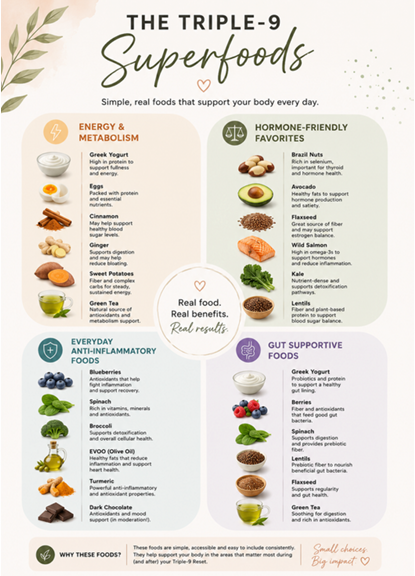
Love tacos? Great — add a quarter avocado on the side. Love pizza? Swap takeout for the cottage cheese crust inside this reset and load it with spinach and lean protein. You don't have to restrict. You have to fuel.
Eat for how you want to feel.
Why strength training matters (especially women 30+)
This isn't about getting bulky. It's about getting stronger. Muscle burns fat.
- Insulin sensitivity improves — your body handles sugar better.
- Cortisol regulates — lower resting stress over time.
- Sex hormones — supports estrogen + testosterone balance through perimenopause, menopause, PCOS.
- Growth hormone + IGF-1 — tissue repair, fat burn, cellular regen.
- Nervous system — better HRV, dopamine + serotonin release, mood, sleep.
Before You Begin
The Mindset That Makes This Work
The scale is the loudest voice in the room and the least honest one. Let's quiet it down before we start.
If you've spent years measuring your worth by a number that fluctuates with your hormones, your sodium, your sleep, and the time of day — I see you. I was you. And I need you to hear this before you turn the next page:
The scale is a snapshot of your relationship with water. Not your progress. Not your worth. Not your effort.
For the next ten days — and honestly, for the rest of this — I want you to measure differently. Ask better questions. Track quieter signals. Because this body you're trying to come home to has been trying to talk to you the whole time.
The questions that actually matter
- How do I feel when I wake up?
- Is the afternoon crash quieter than it was last week?
- Are my clothes fitting differently — even slightly?
- Are my rings looser? Is my face less puffy in the morning?
- Am I sleeping through the night, not just longer?
- Are my cravings softer? My mood steadier? My patience longer?
Those are the real numbers. Those tell you your body is coming online. The scale will catch up — it always does — but it's the slowest, most dramatic, most easily lied-to messenger you have.
The Protein Effect
Here's something most women don't get warned about, and then panic when it happens: when you finally start prioritizing protein, your body can react with a hunger spike and a few pounds of water retention in the first several days. You'll feel hungrier, not less. The scale might tick up. You'll be sure it's "not working."
It is working. Protein is metabolically demanding to digest, and your body is recalibrating after years of being under-fueled. The fix isn't less protein — it's pairing it correctly. Every protein source needs a partner: fiber and a healthy fat. That trio is what stabilizes blood sugar, calms the hunger spike, and tells your body it's safe to let the water go.
The Woosh Effect
This one will save your sanity. When a fat cell empties out, it doesn't shrink immediately — it temporarily fills with water. So for days, sometimes a week or two, you can be actively losing fat while the scale doesn't move and your body looks softer, not leaner.
And then, almost overnight: the woosh. The water releases. The scale drops a few pounds at once. You wake up visibly leaner, less puffy, tighter through the middle. Women who don't know about this quit the week before their woosh. Don't be her.
The plateau before the woosh is not the end of progress. It's the proof of it.
The mindset that holds it all together
- Consistency over intensity. A small thing done daily will outperform a perfect thing done occasionally. Every time.
- Don't quit on a hard day. Quit decisions made when you're tired, bloated, or staring at a scale are almost never accurate.
- The ten days are the doorway, not the destination. What changes your body is what you keep doing on day 11, day 40, day 100 — imperfectly, sustainably, on your terms.
- You're not starting over. You're starting from experience. Every failed diet taught you something about what your body doesn't want. This time you're listening.
Start Here
Match the Reset to How You Actually Feel
The 10 days are designed to support all of this — but lean harder into the one that sounds most like you.
Before you dive in, take 30 seconds and notice what your body has been screaming for. Most women have one symptom that's louder than the rest. That's the reset to lean into first — the others still happen, you just give a little extra attention to the root.
If you feel:
- Bloated, gassy, "puffy" after meals → prioritize the Digestion Reset.
- Exhausted, 3pm-crashing, hangry, shaky between meals → prioritize the Blood Sugar Reset.
- Wired, anxious, can't sleep, holding weight in your midsection → prioritize the Stress Reset.
- Inflamed, achy, swollen rings, slow to recover from workouts → prioritize the Recovery Reset.
- Sluggish, hormonal, foggy, stubborn weight that won't budge → prioritize the Liver Reset.
- Stiff, weak, sore, low energy when you move → prioritize the Movement Reset.
What to Expect
The Arc of the Next 10 Days
So you know what's normal, what's progress, and what's the woosh on its way.
Every body moves at its own pace, but the rhythm tends to look like this. Knowing the arc keeps you from quitting on the day right before everything clicks.
Days 1–3 · Wake-up
You'll feel it the most here. Caffeine cravings, mild headache, maybe a hungrier-than-usual day two. This is your body recalibrating off sugar, processed food, and the stress patterns it's been running on. Drink your water. Eat your protein. Go to bed early.
Days 4–6 · The shift
Bloat starts going down. Rings loosen. Mornings feel less puffy. You'll notice you're not thinking about food between meals. Energy starts to feel steady instead of spiky. This is where most women go, "wait — something is actually different."
Days 7–9 · The plateau (read this twice)
The scale may stall for a few days while your body decides whether it's safe to drop water from emptied fat cells. This is the woosh setting up — not the reset failing. Keep going.
Day 10 · The woosh + the proof
For most women, this is the morning the scale drops a few pounds at once, the middle is visibly tighter, and the face looks like yours again. More importantly: you'll know what supported feels like. That's the part you keep.
The plateau is not the end of progress. It's the proof of it.
Before the Resets
Metabolic Foundations
Five short reads. The lens you'll read every reset through — so nothing feels random, and everything clicks.
Before you start Reset 01, spend five minutes here. These are the ideas that make the next 10 days actually work instead of just feel like another checklist. Read them in order — each one sets up the reset it points to.
Step 1 · Why Your Metabolism Stalled
If you're over 35 and doing everything that "used to work" — eating less, moving more, cutting carbs, adding cardio — and the scale won't move (or worse, it's creeping up), your metabolism didn't break. It adapted.
Somewhere along the way, your body decided it wasn't safe to release weight. Chronic dieting, under-eating protein, high stress, poor sleep, hormonal shifts, and years of blood sugar spikes taught it to hold on. "Eat less, move more" doesn't fix a body in survival mode — it deepens the pattern.
The fix isn't more restriction. It's sending safety signals — enough food, the right food, in the right order, with recovery baked in. That's what the next 6 resets do.
Your metabolism isn't broken. It's protecting you from what you've been asking it to survive.
Step 2 · Eat to Burn, Not Store
Every meal is a message. It tells your body one of two things: we're safe, use this for energy — or we're in trouble, store this for later. The message isn't about calories. It's about what you eat, in what order, and how stable your blood sugar stays afterward.
Protein and fiber first. Healthy fats next. Starch or fruit last. Same foods, different order, completely different hormonal response. Steady blood sugar = steady energy, fewer cravings, and a body that will actually let go of stored fat.
→ This is the foundation for Reset 01: Blood Sugar.
Step 3 · Move to Build, Not Burn Out
After 35, more cardio is often the wrong answer. Long, hard cardio spikes cortisol, breaks down muscle, and tells a stressed body it's in even more danger. Muscle is your metabolic engine — the more you have, the more you burn at rest, and the better your body handles carbs and stress.
The shift: walk daily, lift 2–3x a week, sprinkle in real rest. That's it. You don't need to destroy yourself in the gym. You need to build a body that burns fuel efficiently all day long.
→ This is the foundation for Reset 04: Movement.
Step 4 · Metabolize Your Stress
You cannot out-eat, out-train, or out-supplement chronic stress. When cortisol stays elevated, your body stores fat (especially around the middle), holds onto water, breaks down muscle, and blocks the very hormones that would otherwise let you feel calm, sleep deeply, and burn fat.
De-stressing isn't a bubble bath. It's nervous system regulation — breathwork, morning light, saying no, protecting sleep, and giving your body actual downtime between demands. This is often the missing lever for women who are "doing everything right" and still stuck.
→ This is the foundation for Reset 02: Stress Body and Reset 06: Recovery.
Step 5 · Support Your Body's Exit Routes
Fat loss isn't just about burning fat — it's about getting it out. When fat cells shrink, they release stored hormones and toxins into your bloodstream. If your liver, gut, and lymph aren't moving well, all of that gets reabsorbed. You feel puffy, foggy, hormonal, and stuck.
Daily digestion, hydration, fiber, sweat, and liver-loving foods aren't "detox" gimmicks — they're the exit routes. Open them, and your body can finally let go of what it's been holding.
→ This is the foundation for Reset 03: Digestion and Reset 05: Liver.
Main Reset
The Metabolism Reboot
How to wake your metabolism back up — and why the next 6 resets are the levers that keep it burning.
The Metabolic Foundations just explained why your metabolism stalled. This section is the answer to the question that brought you here: how do I fire it back up?
This is not a 7th reset. It’s the umbrella. The 6 resets coming up are the daily systems that support this reboot. When you stack them, your body gets the consistent safety signal it needs to stop holding on and start letting go.
Your metabolism is not broken. It’s waiting for the right signal to come back online.
Your daily metabolism reboot checklist
Pick the lowest-friction version of each. Done daily beats perfectly once.
- Eat enough. Chronic under-eating is the fastest way to keep your metabolism in survival mode. Aim above your baseline burn (BMR) and avoid crash-dieting again.
- Protein first, every meal. Target 25–30g of protein at breakfast, lunch, and dinner. It has the highest thermic effect, repairs muscle, and keeps you full.
- Fiber + water are non-negotiable. Aim for 25–35g fiber and roughly half your body weight in ounces of water. They move waste out, feed good gut bacteria, and help hormones clear.
- Move after meals. A 10–15 minute walk (or 20–25 squats) after eating improves insulin sensitivity and helps your body use glucose instead of storing it.
- Build muscle 2–3x a week. Muscle is your metabolic engine. More muscle means you burn more at rest and handle carbs better.
- Protect your sleep. 7–9 hours keeps cortisol and insulin in check. One bad night can blunt fat burning the next day.
- Get morning light and regulate stress. Bright light within 30 minutes of waking anchors your cortisol rhythm; small breathwork or boundaries keep it from staying elevated.
- Eat within a 10–12 hour window. A defined overnight break gives insulin and your gut a daily rest, which can make fat burning easier.
- Stop overtraining. Long, hard cardio spikes cortisol and breaks down muscle. Walk more, lift smart, and rest hard.
Hunger & fullness cues
Two simple tools that keep you from overeating and help you actually hear what your body is telling you.
- The 10-minute rule. If you feel hungry between meals, drink a full glass of room-temperature water and wait 10 minutes. Most of the time, your mind is playing tricks — thirst, boredom, or a dip in blood sugar can all feel like hunger. If you’re still hungry after 10 minutes, eat something with protein and fiber. If not, you just saved yourself a snack you didn’t need.
- The burp method. If you burp while eating — especially right around the moment you start to feel full — that’s your body telling you you’re down to roughly 10% of room left in your stomach. Stop there. Take slower bites, chew longer, and give yourself a few minutes to breathe between bites. You’re usually full long before your brain catches up, and eating past that point is one of the quiet reasons the scale won’t move — and why you end up bloated and uncomfortably full.
How the 6 resets support your metabolism
Each reset below is a lever. You don’t need all of them perfect — you need them stacked often enough that your body feels safe.
- Reset 01: Blood Sugar keeps insulin stable, so your body can access stored fat for fuel instead of constantly storing it.
- Reset 02: Stress Body lowers cortisol, protecting muscle and preventing the midsection fat storage that stress drives.
- Reset 03: Digestion makes sure you’re actually absorbing nutrients and clearing waste — both are required for thyroid function and hormone balance.
- Reset 04: Movement builds and preserves muscle, the tissue that determines how much you burn even when you’re not exercising.
- Reset 05: Liver handles hormone detox, converts thyroid hormone to its active form, and keeps your body’s exit routes open.
- Reset 06: Recovery is where the repair happens — sleep, rest, and nervous system recovery reset cortisol so the other resets can work.
Reset One
Stabilize Your Blood Sugar First
If this is off, nothing else works. Not the workouts. Not the meal plans. Not the willpower.
Here's the part no one told you: most women trying to feel better are quietly making their blood sugar worse. Not on purpose. Because they were told to eat less, skip breakfast, push through the 3pm crash with another coffee, and "be good" at dinner.
Your body reads that pattern as danger. And a body in danger doesn't release weight, doesn't sleep well, doesn't ovulate cleanly, and doesn't hand you steady energy. It hoards. It hangs on. It crashes.
Stable blood sugar isn't a diet. It's the foundation every other reset is built on.
Signs your blood sugar is off
- You crave sugar or snacks throughout the day.
- Your energy crashes mid-day (hello, 3pm wall).
- You feel shaky, anxious, or irritable if you don't eat.
- Your body stores fat — especially in the lower stomach.
- You wake up around 3am for no clear reason.
What's actually happening
Every time your blood sugar spikes and crashes, your body floods with cortisol to catch you. Do this three, four, five times a day — for years — and your nervous system lives in low-grade emergency. You feel it as: the shaky 11am, the "I need something sweet" after lunch, the wired-tired evenings, the 3am wake-ups.
Most women try to fix this by eating less. That actually makes it worse. Your body needs consistency to feel safe enough to let go of weight.
The shift
- Eat within 60 minutes of waking. Protein and fiber first. This single move resets your cortisol curve for the whole day. (adding in some healthy fats creates a more complete macronutrient profile that slows digestion and keeps you fuller longer)
- Build every plate like this: protein, fiber, healthy fats, then starch or fruit last. Same foods. Different order. Different body.
- Don't rely on caffeine to replace food. Coffee on an empty stomach is a cortisol bomb. Eat first, then enjoy the coffee.
- Stop skipping meals. Skipping ≠ discipline. Your body reads it as scarcity and clamps down harder on fat.
- Stop fearing carbs. Stop fearing food. Under-eating is the fastest way to keep yourself stuck.
- Stop eating 3-4 hours before bedtime.
- Eat within a 10–12 hour window when possible. (For example, 9 AM to 7 PM.) Giving your pancreas a daily break from insulin production helps lower insulin levels overall, which makes it easier for your body to use stored energy instead of storing more.
- Move after meals. A 10–15 minute walk after lunch and dinner — especially dinner — helps your muscles pull glucose from your bloodstream and flattens the post-meal spike. If you can't walk, do 20–25 bodyweight squats instead within 30–90 minutes of eating. Same effect. Pro tip: scatter 15–20 squats throughout your day — while cooking, working, or playing with the kids — to keep blood sugar steady and add easy movement.
Reset Two
Calm the Inflammation
Your body cannot release what it doesn't feel safe letting go of.
You might feel fine mentally. Calm, even. But your body can be in quiet crisis without your permission — and it's the body that decides whether to hold weight, hold water, hold tension, hold a cycle steady.
This is the reset women skip. They go straight to food and workouts and wonder why nothing moves. The answer is almost always here.
Stress isn't just in your head
Even if you feel mentally calm, your body can still be under stress from:
- Under-eating (yes, this counts as stress).
- Overtraining — especially fasted cardio and back-to-back HIIT.
- Poor sleep, late screens, and 5am alarms with no recovery.
- The constant low-grade pressure to lose weight.
When stress is high, cortisol rises, inflammation rises, water retention goes up, and fat loss stalls. That's the puffy, inflamed, stuck feeling — it's not in your imagination.
What "stress body" actually looks like
- Waking up already tired.
- A jaw that's tight before you've even opened your eyes.
- Bloating that shows up by 4pm no matter what you ate.
- Weight that won't budge despite "doing everything right."
- Periods that feel heavier, later, or more emotional than they used to.
Safety is the prerequisite for change. Your body will not let go until it believes you're not running from something.
The shift
- Ten slow breaths before your first sip of coffee. Out longer than in. This tells your nervous system the day is not an emergency.
- Walk after meals — outside, no phone. Ten minutes. This is medicine, not a workout.
- One non-productive thing a day. Sun on your face. A bath. A real conversation. The body needs proof you are safe.
Reset Three
Fix the Bloating
Bloating isn't about what you eat. It's about how stressed your digestion is.
You've already done the elimination diets. Cut the gluten. Cut the dairy. Cut the joy. And the bloating still came back. Here's why.
Digestion runs on the parasympathetic nervous system — the "rest and digest" side. When you eat in a hurry, eat while stressed, eat while scrolling, or eat after a morning of skipped meals and coffee, your body is in the wrong gear. The food has nowhere to go.
The signal you've been missing
Your gut is wired directly to your brain by the vagus nerve. When that nerve is dim from chronic stress, your stomach acid drops, your gut motility slows, and food sits there fermenting. That's the bloat. That's the heaviness. That's the "I look six months pregnant by dinner."
You don't have a food problem. You have a nervous system problem dressed up as a food problem.
The shift
- Three slow breaths before the first bite. Smell your food. This single ritual flips the vagus nerve back on.
- Sit. Chew. Put the fork down between bites. Digestion starts in your mouth, not your stomach.
- Use the burp method as a stop signal. If you burp mid-meal — especially right as you start feeling full — you're down to about 10% room left in your stomach. Stop there. Eating past that point is how bloat shows up.
- Warm water, not iced. Especially around meals. Cold water constricts the digestive vessels you're trying to wake up.
- Stop snacking constantly. Your gut needs 3–4 hours between meals to actually clean itself out. That's where the bloat hides.
- Keep food simple before you make it "perfect." A pile of "healthy" foods your gut isn't ready for (raw kale, beans, kombucha, protein powder, sugar alcohols) can bloat you more than a real meal. Simple, warm, cooked, repeatable wins right now.
- Aim for 5–7g of fiber before every meal — or at the very least with every meal. Fiber slows the release of sugar into your bloodstream, feeds the good gut bacteria doing the healing, and physically sweeps out what your body is trying to let go of. It's the single most underrated piece of "de-bloating."
- Eat within a 10–12 hour window when possible. A shorter overnight break gives your gut time to clean itself out through motility (the "migrating motor complex"), which reduces bloating.
- Move after meals (especially dinner). A 10–15 minute walk after lunch or dinner stimulates digestion, prevents food from sitting and fermenting, and reduces the puffy, heavy feeling. After dinner matters most because digestion naturally slows as your body winds down for sleep, and lying down soon after a big meal can trap food in the gut, spike blood sugar, and leave you bloated by morning. If you can't walk, do 20–25 bodyweight squats instead within 30–90 minutes of eating. Same effect.
Easy ways to get 5–7g of fiber
Two before the meal
- Overnight chia pudding. 3 tbsp chia seeds + ¾ cup unsweetened almond or coconut milk + a splash of vanilla + a drizzle of honey or maple. Stir, refrigerate overnight. Top with berries in the morning. ~11g fiber. Eat a few spoonfuls 15 minutes before breakfast.
- Berry + flax "pre-meal" cup. ½ cup raspberries or blackberries + 1 tbsp ground flaxseed + a spoonful of Greek yogurt. ~7g fiber in under a minute. Perfect before lunch or dinner.
Two to add into the meal
- Toss ½ cup of black beans, lentils, or edamame into your salad, taco bowl, soup, or pasta. Instant +7g fiber with zero extra cooking.
- Sub half your rice or pasta for riced cauliflower, roasted broccoli, or spiralized zucchini. Same volume on your plate, double the fiber, way less bloat.
Reset Four
Stop Doing Too Much
For most women, doing more is what's keeping them stuck. More workouts ≠ better results.
We were sold a story: that the harder we punish our bodies, the more we'll be rewarded. So we add another HIIT class. Another fasted run. Another "should." And the scale doesn't move, the energy gets worse, and the cycle gets weirder.
Here's the truth your trainer probably won't tell you: a stressed body cannot be trained out of being stressed. You have to talk to it in a different language first.
The 3 Body-Type Starting Points
Read these honestly. You'll know which one is you in two sentences.
The Depleted Body
Signs: You wake up tired. You crave sugar by 3pm. You've lost your period or it's irregular. You feel cold often. You used to be able to push hard — and now you can't.
Your move: Walk. Lift heavy, slow, 2x a week. Long, boring cardio is the wrong medicine. You need to rebuild capacity, not burn it off.
The Inflamed Body
Signs: You bloat easily. You hold water. Your face feels puffy in the morning. Your joints ache. Workouts leave you sore for days.
Your move: Daily walking. Mobility. Strength 2–3x a week with full recovery. No HIIT until inflammation is down — it pours fuel on the fire.
The Stuck Body
Signs: Your blood sugar feels steadier. Sleep is okay. Energy is okay. But nothing changes — weight, body comp, how clothes fit. You feel plateaued.
Your move: This is when strength training 3–4x a week and short, intentional intervals start to work. You finally have the foundation for them to.
The right movement for your body right now is not the same as the right movement for your body in six months. Meet yourself where you are.
Reset Five
Wake Up Your Liver
Your liver is the real fat-burning organ. Not your treadmill. Not your fasted cardio. Your liver.
We've been taught to chase fat loss with sweat. But the organ that actually decides whether your body burns fat or stores it is quietly running in the background, overworked and under-supported. Your liver.
Every hormone you make, every blood-sugar swing, every drink, every "natural flavor," every stress hit, every old birth-control pill, every late dinner — your liver processes all of it. When it's congested, your body stops burning fat and starts parking it. Especially around the middle.
You can't out-train a sluggish liver. You have to give it room to do its job.
Signs your liver is asking for help
- Stubborn weight around the midsection that won't budge.
- Waking up between 1–3am for no clear reason.
- Heavier or more painful periods than you used to have.
- Skin that breaks out along the jaw or looks dull.
- Headaches, irritability, or that "puffy and inflamed" morning face.
The shift
- Warm lemon water before coffee. A quiet nudge that tells your liver the day has started.
- Bitter greens daily. Arugula, dandelion, radicchio. Bitter is the flavor your liver actually craves — and the one we've removed from modern food.
- Cruciferous vegetables most days. Broccoli, cauliflower, brussels sprouts. They give your liver the exact compounds it needs to clear used-up hormones out of your body.
- Cap the nightly wine. Even "just one" puts your liver on cleanup duty for hours — instead of doing the overnight repair work that actually burns fat.
- Sweat on purpose 2–3x a week. A sauna, a hot bath, a brisk walk that flushes your face. Sweat is a real exit route for what your liver processes.
Reset Six
Recover Like It's the Work
Sleep, light, and downtime are not rewards for working hard. They are the work.
Every change you want — calmer mood, steadier weight, clearer skin, easier cycles, sharper brain — is built at night. Not in the gym. Not in the kitchen. In the eight hours your body uses to rebuild you.
Skip recovery and everything else you do becomes 30% effective. This is the quietest reset and the most powerful one.
The shift
- Morning light in your eyes within 30 minutes of waking. Two minutes outside is enough. This sets your sleep that night.
- Dim the house after sunset. Overhead lights off. Lamps only. Your hormones read light like a clock.
- Same bedtime. Every night. Even Saturdays. Your nervous system loves rhythm more than it loves sleep-ins.
- One full day a week of doing less on purpose. Not lazy. Strategic.
A Personal Note
Why This Reset, From Me to You
Before the numbers — the feeling. Because that's where it actually started.
I want to tell you the truth about where I started, because I think you might be standing somewhere close to it right now.
I felt like my body was failing me. I was doing everything I was told to do — eating less, working out more, "being good" — and every appointment I left with the same answer: eat less, move more. I'd nod, go home, and quietly wonder what was wrong with me that the most basic advice in the world wasn't working. I was exhausted. I'd get winded after a 10-minute walk. I was sick almost twice a month. My sleep felt broken even on the nights I "got enough." I didn't recognize the woman in the mirror, and I didn't recognize the way my body responded to her anymore.
At my heaviest I was 209 lbs. But that number isn't the part of the story I want you to remember. The part I want you to remember is that I wasn't lazy. I wasn't undisciplined. I was a woman whose body had stopped feeling safe — and no amount of punishment was going to talk it back into trusting me.
The reset didn't start with a workout plan. It started with finally listening to a body I'd spent years overriding.
What actually shifted first
Not the scale. The scale is almost never the first thing. Here's what I noticed in those first ten days, in the order they happened:
- The bloating and puffiness went down. My face in the morning looked like mine again.
- I stopped getting sick all the time. The constant low-grade colds quietly disappeared.
- My clothes started fitting looser — before the scale moved at all.
- I slept through the night. For me it was never just the hours, it was the quality. That's what was destroying me.
- My energy came back. I could power through a workout without coffee or pre-workout. The woman who used to get winded walking the dog was gone.
What it became
Over the next five months I lost 32 lbs and went from a size 12 to a size 7. But I want to be careful with that sentence, because the number is the part that sells and the process is the part that works. The number happened because I stopped doing more. I started doing what I could realistically sustain without depriving myself.
After the ten days, I added my favorite foods back in — on my terms. I'd still have tacos, I'd just add a side of avocado. I swapped take-out pizza for an easy high-protein homemade one. I stopped treating food like a moral test and started treating it like information. That's the part that lasted.
I didn't shrink my body into submission. I woke it back up. The weight loss was the side effect of a body that finally felt safe.
Your results will look like yours, not mine. Your timeline will be yours. But the order — safety first, foundation first, listening first — that part is the same for every woman I've ever watched come back to life. And it starts with these ten days.
Before You Begin
Your Personal Numbers (the only "diet math" you need)
Figure these out before Day 1 so you're not guessing once you start.
1 lb of fat ≈ 3,500 calories. A 500-calorie daily deficit = ~1 lb of fat loss per week (not counting water). Most diet programs hide that simple formula behind 47 rules. Here it is — and here's a calculator so you can plug in your own body and walk away with your numbers before the reset starts.
Your Personal Numbers — Calculator
Plug in your body. Walk away with your targets.
Estimates only — not medical advice. Recalculate every 10–15 lbs of weight loss.
The formula (in case you'd rather do it by hand)
Women: BMR = (4.536 × weight in lbs) + (15.88 × height in inches) − (5 × age in years) − 161
Daily calorie needs (TDEE) — multiply your BMR by your activity level:
- Sedentary: BMR × 1.2 (little to no exercise)
- Lightly active: BMR × 1.375 (light exercise 1–3 days/week)
- Moderately active: BMR × 1.55 (moderate exercise 3–5 days/week)
- Very active: BMR × 1.725 (hard exercise 6–7 days/week)
- Extra active: BMR × 1.9 (intense daily exercise)
- Daily calories to eat for fat loss: TDEE − 350 to 500. A healthy deficit. Cut more and your body shifts into fat-storing mode — cortisol and hormones go into overdrive. You have to eat.
- Protein (g/day): ideal body weight × 0.8 — preserves muscle while you lose fat.
- Fats (g/day): body weight × 0.3 — safe hormone balance.
- Fiber (g/day): calories ÷ 1,000 × 14 — healthy gut.
- Carbs (g/day): (calories − body weight × 6) ÷ 4 — energy.
What I learned the hard way: I plateaued when I dropped my calories lower — less food puts your body into storage mode. Eat enough to keep your metabolism awake.
These numbers are tools. Not rules. You don't have to chase perfection to see progress.
No Scale Required
The Macro Cheat Sheet
How to eyeball your portions, understand raw vs. cooked, and build a plate without weighing every bite.
Once you know your numbers, the next question is always the same: okay… but how much is that on my plate? The recipes inside your 10-day reset spell it all out for you. But the meal ideas — and everything you eat after day 10 — don't come with a recipe card. This cheat sheet is how you stop guessing.
Hand portions (your built-in food scale)
Your hand is scaled to your body — bigger person, bigger hand, bigger portion needs. Use it any time you don't have a scale (restaurants, travel, someone else's kitchen, or just because you're tired of measuring).
- Protein → 1 palm (thickness + width of your palm, no fingers) ≈ 20–30g protein. Chicken, fish, steak, ground turkey, tofu.
- Carbs → 1 cupped hand ≈ 20–30g carbs. Rice, pasta, potatoes, oats, fruit, tortillas.
- Veggies → 1 fist (or two — go wild) ≈ ~5g carbs + fiber. Basically unlimited during the reset.
- Fats → 1 thumb ≈ ~10g fat. Oil, butter, nut butter, cheese, avocado.
Raw vs. cooked weights (the #1 thing people get wrong)
Nutrition labels on meat and grains are almost always raw. Once you cook them, the weight changes because of water. Weigh raw when you can — it's the most accurate. If you can only weigh cooked, use these conversions:
- Chicken breast: 4 oz raw ≈ 3 oz cooked (loses ~25% water). So 4 oz cooked ≈ ~5.3 oz raw.
- Ground beef / turkey: 4 oz raw ≈ 3 oz cooked. Drain the fat for leaner macros.
- Steak / pork: 4 oz raw ≈ 3 oz cooked.
- Fish / shrimp: 4 oz raw ≈ 3–3.5 oz cooked (less shrinkage).
- Rice: ¼ cup dry (uncooked) ≈ ¾ cup cooked ≈ ~45g carbs. Rice gains weight from water.
- Pasta: 2 oz dry ≈ 1 cup cooked ≈ ~42g carbs. Also gains weight from water.
- Oats: ½ cup dry ≈ 1 cup cooked ≈ ~27g carbs.
- Dry beans / lentils: ¼ cup dry ≈ ¾ cup cooked.
Build a plate — no math, no scale
Half of your plate = veggies. A quarter = protein (palm). A quarter = carbs (cupped hand). A thumb of fat on the side. That's a balanced meal without opening a single tracker.
- Breakfast: 3 eggs + 1 slice sourdough + berries + a thumb of avocado.
- Lunch: Palm of grilled chicken + cupped hand of rice + fist of roasted veggies + thumb of olive oil.
- Dinner: Palm of salmon + cupped hand of sweet potato + two fists of salad + thumb of dressing.
- Snack: Greek yogurt (palm-ish) + berries (cupped hand) + a thumb of nut butter or granola.
Quick-reference cheat sheet
- 1 palm protein = ~20–30g protein
- 1 cupped hand carbs = ~20–30g carbs
- 1 fist veggies = ~5g carbs + fiber
- 1 thumb fat = ~10g fat
- 4 oz raw meat = ~3 oz cooked
- ¼ cup dry rice = ~¾ cup cooked (~45g carbs)
- 2 oz dry pasta = ~1 cup cooked (~42g carbs)
- ½ cup dry oats = ~1 cup cooked (~27g carbs)
- 1 tbsp oil / nut butter = ~14g fat
- 1 large egg = ~6g protein, ~5g fat
You don't need to weigh every bite for the rest of your life. You need to know what balance looks like on a plate.
You're ready
Your 10-Day Triple-9 Reset is waiting.
You now understand the six resets. The 10-day plan walks you through them, day by day, meal by meal, breath by breath. It's already included with your purchase.
Get my 10-day plan →Already included. No extra cost.
Day 11 and Beyond
What To Focus On After The 10 Days
The reset is the doorway. What you do on day 11 is what changes your body for good.
The goal was never to lose weight as fast as possible and then sprint back to the habits that broke you. The goal was to feel better and build habits you'd actually keep. The reset was just the kick in the butt.
Because what good is losing weight if the process is so miserable you can't maintain it? I'd rather lose a little slower while enjoying my life than spend every day feeling restricted. And that's exactly what I'm doing — and still losing.
What I'm still doing
- Prioritizing protein + fiber at every meal.
- Walking 30 min a day, 6 days a week.
- Strength training 20 min, 4–5 days a week (reuse the workouts from this reset).
- Morning sunshine. Real sleep. Hydration (minimum 64–80 oz).
- Logging meals in MyFitnessPal — paying attention, not obsessing.
What's changed
I added my favorite foods back in. I still eat tacos. I still eat pizza. I still do date nights and family dinners and birthdays. The difference: those foods aren't the foundation of my day anymore — they're part of my life.
One of the biggest lessons: the more we tell ourselves we "can't" have something, the more we obsess. I add a side of avocado with my tacos now. I swap takeout pizza for a homemade high-protein one. Small upgrades. Same favorites.
Eat for how you want to feel. When I eat like crap, I feel like crap. You just spent 10 days proving which foods make you feel alive. Keep eating those.
The real goal
Small habits. Big impact. Choose yourself again tomorrow. And the day after. That's where results that last actually live.
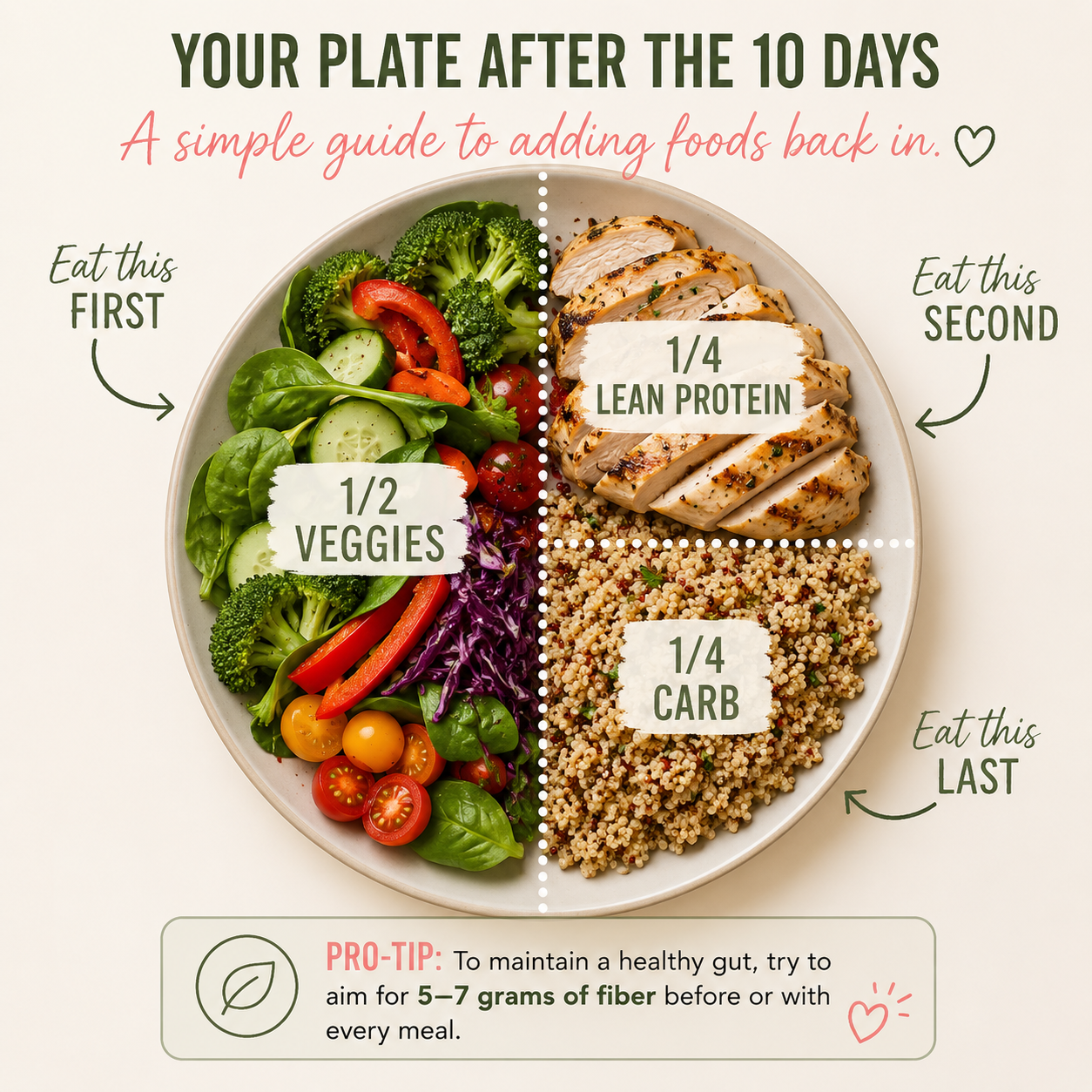
A note before you add your foods back in
Follow the plate. Not perfection.
This plate is your new north star — half veggies, a quarter lean protein, a quarter carb, and 5–7g of fiber before or with every meal. Eat veggies first, protein second, carbs last. That single order keeps your blood sugar steady, your energy up, and your cravings quiet.
But hear me on this: you do not need to eat a chicken-and-quinoa bowl three times a day for the rest of your life. That is not the goal. The goal is to look at whatever you're eating and adjust it toward this ratio. Some days it'll be perfect. Most days it won't. Both are wins.
Real meals, adjusted (no chicken-and-rice required)
- Breakfast: eggs & toast. Instead of 2 eggs + 2 slices of white toast, do 3 eggs (protein) + 1 slice sourdough or whole-grain (carb) + a big handful of sautéed spinach, tomatoes, and peppers (veggies + fiber) + ½ avocado. Same breakfast. Real ratio.
- Lunch: a sandwich. Turkey or chicken sandwich? Add double the meat, load it with spinach, cucumbers, tomato, and red onion, swap chips for baby carrots or an apple, and you just built the plate — bread and all.
- Dinner: tacos. Use 2 tortillas instead of 4 (carb), fill with seasoned ground turkey or shredded chicken (protein), and pile on lettuce, peppers, onions, salsa, and a scoop of black beans (veggies + fiber). Same tacos. Same joy. Better plate.
- Pasta night. Do half regular pasta, half zucchini noodles or spaghetti squash. Double the marinara veggies. Add grilled chicken, shrimp, or lean ground beef on top. You just cut the carbs in half and doubled the protein and fiber without giving up pasta night.
- Pizza. One or two slices + a big side salad with olive oil and lemon + a grilled chicken breast on the side. The plate wins. Pizza still happens.
- Takeout / rushed day. Grab a rotisserie chicken, a bagged salad, a microwave rice pouch. 8 minutes. The plate.
You just spent 10 days proving you can do hard things and still enjoy food. Now you get to make it yours. Add the foods you love back in one at a time, notice how you feel, and adjust the plate around them. That is the skill. Not the meal plan — the skill.
Progress, not a performance. Every single time.
Optional Bonus
Metabolic Support Tea
A simple post-reset ritual you can add 3–5 days a week for extra support — not something you missed during the 10 days.
I did not drink this tea during my original 10-day Triple-9 Reset. The 9.2 pounds and 9 inches came from the system exactly as you've read it.
After the reset, I started looking for small, easy habits to keep supporting my metabolism, gut health, blood sugar, and inflammation. This tea combination is one I now enjoy 3–5 days a week as a bonus — not a requirement, not a magic fix, just one more supportive ritual.
No single tea changes your body. Consistent meals, movement, sleep, and hydration do. This is just an optional add-on.
How to use it
Drink it between breakfast and lunch, 3–5 days a week. Because oolong contains caffeine, I avoid it late afternoon or evening. I usually have it on the days I want a little extra metabolic and digestive support.
Note: check with your doctor before starting anything new, especially if you take heart or blood pressure medications — hawthorn can interact with some medications.
☕ Triple-9 Metabolic Support Tea
- 2 cups filtered water
- 1 tablespoon cacao nibs
- 1 tablespoon dried hawthorn berries (or sliced dried hawthorn)
- 1 Ceylon cinnamon stick
- 1 teaspoon loose-leaf oolong tea (or 1 tea bag)
Directions
- Bring 2 cups of water to a gentle boil.
- Add the cacao nibs and simmer for 8–10 minutes.
- Add the hawthorn berries and Ceylon cinnamon stick.
- Simmer another 5 minutes.
- Remove from the heat.
- Add the oolong tea.
- Cover and steep for 3–4 minutes.
- Strain and enjoy.
Why these ingredients
🍫 Cacao Nibs
Rich in antioxidants, magnesium, and polyphenols that support a healthy gut microbiome and may improve insulin sensitivity.
🍵 Oolong Tea
Contains antioxidants and catechins studied for supporting metabolism, fat oxidation, and balanced blood sugar.
❤️ Hawthorn Berries
Traditionally used to support healthy circulation and provide antioxidant protection that may help reduce oxidative stress and inflammation.
🌿 Ceylon Cinnamon
Studied for supporting healthy blood sugar and insulin sensitivity, with much lower coumarin levels than common Cassia cinnamon.
You Did It
I am so proud of you.
If you've made it this far, I hope you're as proud of yourself as I am of you. Over the last 10 days you practiced showing up for yourself in small ways that add up to meaningful change. You prioritized protein and fiber. You moved your body. You stayed hydrated. You simplified your meals. You made progress.
Whether your biggest win was losing inches, having more energy, sleeping better, feeling less bloated, or proving to yourself that you could actually finish something you started — it matters.
You don't have to be perfect to create change. You just have to keep showing up.
Take the habits that worked for you and keep building on them. The goal was never just to lose weight. The goal was to help you feel like yourself again. And this is only the beginning.
Your Triple-9 Reset reflection
Before you move on, take a few moments to celebrate how far you've come. Some of the most meaningful changes happen beyond the scale.
Digital version: fill these in right here — your answers stay on this page for as long as you keep the tab open. PDF version: write your answers down by hand. Seeing them on paper makes them feel more real (and gives you something tangible to look back on).
The scale
Measurements
Energy & wellness check-in
Compared to day 1…
What are you most proud of?
What habits do you want to continue?
The goal was never perfection. The goal was to prove to yourself that small actions repeated consistently can change the way you feel.
I'd love to hear from you
First of all — thank you. Thank you for trusting me enough to be a small part of your journey. There are hundreds of programs out there, and the fact that you chose this one means more than you know.
If this reset helped you in any way, I'd be so grateful if you shared your experience with me. Your feedback helps me keep creating resources that truly support women like you.
A few questions I'd love you to answer:
- • What results did you notice during the Triple-9 Reset?
- • What was your favorite meal?
- • What habit made the biggest difference for you?
- • What surprised you most about this experience?
- • Is there anything you'd change or improve?
- • Would you recommend this reset to a friend? Why or why not?
If you're comfortable sharing publicly, I'd love to celebrate your wins with you. Send me your:
- ✓ Before and after photos
- ✓ Measurements
- ✓ Weight loss results
- ✓ Non-scale victories
- ✓ Favorite recipes
You can connect with me here:
- Instagram: @itschelsiross
- Email: hello@chelsirossco.com
Thank you again for letting me walk alongside you these last 10 days.
Cheering you on always,
Chelsi
P.S. Let me know if you'd be comfortable letting me share your story to inspire other women starting their own Triple-9 journey. (I can leave your face or name out of it if you'd like. 😊)